---
title: PG&E and SCE Electricity Rate Changes for California Homeowners (2026 Update)
description: Discover how rising electricity rates in California are reshaping homeowner decisions on energy costs and solar options in 2026. Explore solutions to save on electricity.
image: https://blog.citadelrs.com/hubfs/AI-Generated%20Media/Images/Sidebyside%20comparison%20graphic%20of%20a%20high%20utility%20bill%20and%20a%20lower%20bill%20after%20solar%20with%20a%20California%20home%20with%20solar%20panels%20in%20the%20background%20financial.png
---
CALL OR [CLICK](https://info.citadelrs.com/get-a-quote) TODAY FOR A **FREE** SOLAR CONSULTATION: [(833) 410-6579](tel:8334106579)
-
-
-
-
-
-
Call Now:[(833) 410-6579](tel:%20(833)%20410-6579)
[](https://www.citadelrs.com/)
-
-
-
-
- [Homeowners](https://www.citadelrs.com/residential/)
- [Solar](https://www.citadelrs.com/residential/solar/)
- [Solar Energy Storage](https://www.citadelrs.com/residential/solar-battery-energy-storage/)
- [Solar Maintainance](https://www.citadelrs.com/residential/solar-maintenance/)
- [Roofing](https://www.citadelrs.com/residential/roofing/)
- [Smart Panels](https://www.citadelrs.com/residential/residential-smart-panels/)
- [Customer Stories](https://www.citadelrs.com/residential/customer-stories/)
- [FAQ](https://www.citadelrs.com/residential/faqs/)
- [Businesses](https://www.citadelrs.com/commercial/)
- [Solar](https://www.citadelrs.com/commercial/solar/)
- [Solar Energy Storage](https://www.citadelrs.com/commercial/solar-battery-energy-storage/)
- [Solar Maintainance](https://www.citadelrs.com/commercial/solar-maintenance/)
- [Roofing](https://www.citadelrs.com/commercial/roofing/)
- [Portfolio](https://www.citadelrs.com/commercial/portfolio/)
- [FAQ](https://www.citadelrs.com/commercial/faqs/)
- [Homebuilders](https://www.citadelrs.com/homebuilders/)
- [Service Areas](https://www.citadelrs.com/service-areas/)
- [Northern California](https://www.citadelrs.com/service-areas/northern-california/)
- [Central California](https://www.citadelrs.com/service-areas/central-california/)
- [Southern California](https://www.citadelrs.com/service-areas/southern-california/)
- [About Us](https://www.citadelrs.com/about-us/)
- [The Citadel Way](https://www.citadelrs.com/about-us/why-citadel/)
- [Our Team](https://www.citadelrs.com/about-us/our-team/)
- [Testimonials & Reviews](https://www.citadelrs.com/about-us/reviews-testimonials/)
- [Referral Program](https://www.citadelrs.com/about-us/referral-program/)
- [Community Involvement](https://www.citadelrs.com/about-us/community-involvement/)
- [Careers](https://www.citadelrs.com/careers/)
- [Learn](https://www.citadelrs.com/learn/)
- [Solar](https://www.citadelrs.com/learn/solar/)
- [Energy Storage](https://www.citadelrs.com/learn/solar-battery-energy-storage/)
- [Roofing](https://www.citadelrs.com/learn/roofing/)
- [Financing](https://www.citadelrs.com/learn/financing/)
- [News](https://blog.citadelrs.com/news)
- [Blog](https://blog.citadelrs.com)
- [Contact Us](https://www.citadelrs.com/contact-us/)
**FREE** CONSULTATION: [(800) 400-2852](tel:8004002852)
Call Now:[(800) 400-2852](tel:%20(800)%20400-2852)
[](https://www.citadelrs.com/)
-
-
-
-
- [Homeowners](https://www.citadelrs.com/residential/)
- [Solar](https://www.citadelrs.com/residential/solar/)
- [Solar Energy Storage](https://www.citadelrs.com/residential/solar-battery-energy-storage/)
- [Solar Maintainance](https://www.citadelrs.com/residential/solar-maintenance/)
- [Roofing](https://www.citadelrs.com/residential/roofing/)
- [Smart Panels](https://www.citadelrs.com/residential/residential-smart-panels/)
- [Customer Stories](https://www.citadelrs.com/residential/customer-stories/)
- [FAQ](https://www.citadelrs.com/residential/faqs/)
- [Businesses](https://www.citadelrs.com/commercial/)
- [Solar](https://www.citadelrs.com/commercial/solar/)
- [Solar Energy Storage](https://www.citadelrs.com/commercial/solar-battery-energy-storage/)
- [Solar Maintainance](https://www.citadelrs.com/commercial/solar-maintenance/)
- [Roofing](https://www.citadelrs.com/commercial/roofing/)
- [Portfolio](https://www.citadelrs.com/commercial/portfolio/)
- [FAQ](https://www.citadelrs.com/commercial/faqs/)
- [Homebuilders](https://www.citadelrs.com/homebuilders/)
- [Service Areas](https://www.citadelrs.com/service-areas/)
- [Northern California](https://www.citadelrs.com/service-areas/northern-california/)
- [Central California](https://www.citadelrs.com/service-areas/central-california/)
- [Southern California](https://www.citadelrs.com/service-areas/southern-california/)
- [About Us](https://www.citadelrs.com/about-us/)
- [The Citadel Way](https://www.citadelrs.com/about-us/why-citadel/)
- [Our Team](https://www.citadelrs.com/about-us/our-team/)
- [Testimonials & Reviews](https://www.citadelrs.com/about-us/reviews-testimonials/)
- [Referral Program](https://www.citadelrs.com/about-us/referral-program/)
- [Community Involvement](https://www.citadelrs.com/about-us/community-involvement/)
- [Careers](https://www.citadelrs.com/careers/)
- [Learn](https://www.citadelrs.com/learn/)
- [Solar](https://www.citadelrs.com/learn/solar/)
- [Energy Storage](https://www.citadelrs.com/learn/solar-battery-energy-storage/)
- [Roofing](https://www.citadelrs.com/learn/roofing/)
- [Financing](https://www.citadelrs.com/learn/financing/)
- [News](https://blog.citadelrs.com/news)
- [Blog](https://blog.citadelrs.com)
- [Contact Us](https://www.citadelrs.com/contact-us/)
[](https://www.citadelrs.com/get-a-quote/)
# OUR RECENT BLOGS
# PG&E and SCE Electricity Rate Changes for California Homeowners (2026 Update)
## Published Apr. 06, 2026
## **PG&E and SCE Rate Changes for Homeowners**
### **How Utility Costs Are Shaping Residential Solar Choices in 2026**
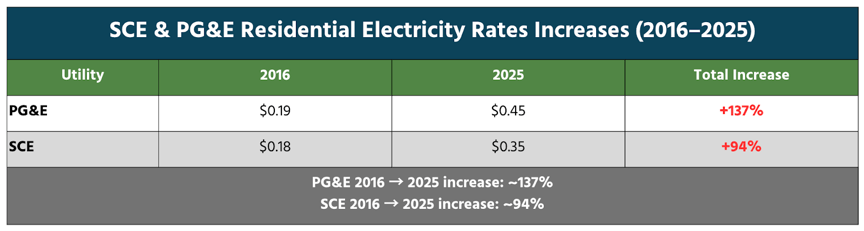
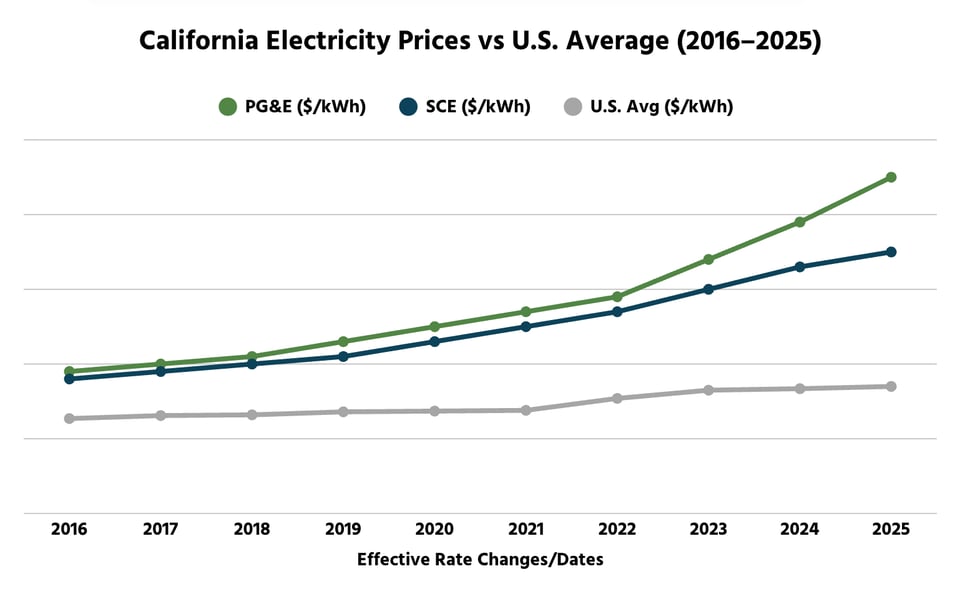
If you live in the Golden State and you’ve noticed your power bill climbing over the last few years, you’re not alone. Until a few years ago, homeowners in California have treated electricity like a steady monthly expense… mortgage, insurance, utilities. Rates rose slowly and predictably. Not anymore. [In California, average residential electricity costs surged 47 percent from 2019 to 2023](https://insideclimatenews.org/news/05112025/california-investor-owned-utilities-vs-public-utilities/), and are now twice as high as the national average. Many households have seen sharp jumps in their power bills, transforming electricity from an (almost) fixed cost to one of the least predictable parts of the monthly budget.
Several factors are driving these changes. Time-of-use pricing and demand-based rules have become more complicated and peak pricing windows seem to move around every time a family has adjusted to a new routine. A homeowner can’t just look at last month’s bill and assume what next month will look like, which makes long-term budgeting feel like a guessing game.
The main reason for these price hikes is wildfire spending. From 2019 through 2023, the California Public Utilities Commission authorized the three largest utilities to [collect $27 billion from customers to cover wildfire prevention and insurance](https://calmatters.org/environment/2024/12/pge-utilities-wildfire-prevention-customer-bills-california/). Those costs now make up a significant share of residential electricity rates.
## **Why Residential Utility Costs Feel Less Predictable**
Many of the increases in residential electric bills feel sudden. Costs tied to wildfire prevention, grid upgrades, and routine system work are approved separately and then added to bills later. That timing mismatch means new charges can appear mid-year, catching homeowners off-guard.
Shifting rate structures also result in rate unpredictability. A short stretch of heavy usage can blow up the bill for the entire month. Time-of-use pricing makes the time of day that energy is used almost as important as how much is used. Homes that use more power during peak evening hours pay significantly more than households using the same amount of power during off-peak periods.
## **Southern California Edison Rates**
### **A Decade of Rising Rates**
Over the past decade, [Southern California Edison’s residential electricity rates have climbed by more than 80%](https://www.ocpower.org/newsroom/sce-rate-changes-explained/). These increases have not been gradual, with dramatic spikes occurring periodically. For example, [April 2020 saw a 7% increase](https://www.energytoolbase.com/blog/utility-rates/southern-california-edison-is-going-to-increase-their-rates/#:~:text=Southern%20California%20Edison%20(SCE)%2C,Newsom%20on%20March%2019th.), and rates rose by more than 10% in October 2025.
### **Demand Charges and Time-of-Use**
Demand-based pricing and peak-hour rates have made budgeting more difficult. Short bursts of high usage can affect the entire billing cycle, even when this month’s total consumption was the same as last month’s. [Some plans now include extra charges based on how much electricity is used at once](https://calmatters.org/housing/2024/05/californians-electricity-rates/#:~:text=Starting%20in%20late%202025%20for,of%20either%20$6%20or%20$12). Because of this, running several large appliances during evening hours can raise costs more than expected. For many households, shifting cooking, heating and cooling, or laundry outside peak windows is unrealistic, which makes it more difficult to avoid paying premium energy prices.
### **What’s Behind the Increases**
Wildfire mitigation is the main cost driver. Southern California Edison is upgrading more than [1,000 miles of overhead lines and burying 212 miles of infrastructure in high-risk areas through 2028](https://www.sce.com/save-money/rates-financing/residential-rate-plans/understanding-updates-to-your-bill#:~:text=The%20General%20Rate%20Case%20funds,fixed%20operational%20and%20maintenance%20costs). In January 2025, the California Public Utilities Commission approved SCE’s request to recover [close to $2 billion](https://www.sce.com/save-money/rates-financing/residential-rate-plans/understanding-updates-to-your-bill#:~:text=The%20General%20Rate%20Case%20funds,fixed%20operational%20and%20maintenance%20costs) tied to the 2017–2018 Thomas Fire and the mudslides that followed.
Beyond wildfire costs, most remaining increases are tied to grid upgrades. [Regulators have approved plans that allow SCE to raise what it collects from customers each year through 2028 to fund this work](https://www.cpuc.ca.gov/news-and-updates/all-news/cpuc-decision-in-edison-rate-case-prioritizes-affordability-safety-and-reliability). For homeowners, this means cost increases arrive year after year and stack onto already bloated rates.
## **Pacific Gas and Electric Rates**
### **The Decade in Numbers**
Today, Pacific Gas and Electric residential rates look very different from a decade ago. [Rates have more than doubled since the mid-2010s](https://www.publicadvocates.cpuc.ca.gov/-/media/cal-advocates-website/files/press-room/reports-and-analyses/250827-public-advocates-office-q2-2025-rates-report.pdf), with residential prices increasing 104% between January 2015 and April 2025.
[Since 2022, a series of rate hikes totaling more than 40% has arrived in stages](https://www.publicadvocates.cpuc.ca.gov/press-room/commentary/250423-pge-seeks-another-multi-billion-dollar-rate-increase#:~:text=Affordability%20and%20Customer%20Risk,long%2Dterm%20performance%20and%20affordability). These increases have compounded over a short period, making future bills harder for households to predict.
### **Regional Impacts**
PG&E’s service territory covers a wide range of climates and usage patterns. Inland areas experience peak pricing differently than coastal regions, and time-of-use schedules vary by location. The same household usage pattern can produce very different bills depending on where a home is located.
Wildfire-related costs can also trigger unexpected problems. [These charges follow separate approval timelines from normal rate cases, so new line items can appear without warning](https://www.publicadvocates.cpuc.ca.gov/-/media/cal-advocates-website/files/press-room/reports-and-analyses/240613-public-advocates-office-electric-ious-wildfire-cost-increases.pdf). From a homeowner’s perspective, rates can feel like they jump at unexpected times.
### **What’s Driving PG&E’s Increases**
Wildfire prevention is a huge part of PG&E’s spending. [The utility plans to invest $7.4 billion from 2023 to 2026](https://investor.pgecorp.com/news-events/press-releases/press-release-details/2021/To-Meet-the-Evolving-Needs-of-its-16-Million-Customers-PGE-Proposes-Critical-Investments-to-Reduce-Wildfire-Risk-Enhance-Energy-System-Safety-and-Reliability-and-Deliver-More-Clean-Energy-for-California/default.aspx#:~:text=SAN%20FRANCISCO%2D%2D\(BUSINESS%20WIRE,reliable%20and%20clean%20energy%20service). That number includes more than [$1 billion for vegetation management and over 1,600 miles of undergrounding](https://www.pge.com/en/newsroom/currents/safety/pg-e-reaches-significant-undergrounding-milestone---burying-more.html#:~:text=As%20of%20this%20week%2C%20PG&E,Forest%20Service%20and%20other%20utilities).
Distribution costs have grown faster than any other part of PG&E’s revenue requirement. Transmission and [distribution spending more than doubled between 2016 and 2025](https://www.cpuc.ca.gov/-/media/cpuc-website/divisions/office-of-governmental-affairs-division/reports/2025/ab67_puc913_102425.pdf), supporting grid upgrades, electrification, and long-deferred maintenance.
In late 2024, PG&E requested an [additional $3.1 billion for grid connection work](https://www.publicadvocates.cpuc.ca.gov/press-room/commentary/250423-pge-seeks-another-multi-billion-dollar-rate-increase#:~:text=Just%20months%20after%20the%20California,101%25%20over%20the%20last%20decade) for 2025 and 2026. That’s on top of $1.3 billion already authorized. These infrastructure costs show up in demand charges and higher per-kilowatt-hour rates on customers’ utility bills.
## **Why Upcoming Increases Matter**
Until about 10 years ago, rate hikes layered onto relatively low base rates. Today, new increases are stacking on top of already elevated prices. To many families, a 6% bump on top of several other recent bumps feels less like a cost of living hike and more like the final straw.
### **Compounding Effects on Household Budgets**
When prices rise from a higher starting point, each new increase carries more weight. A 6% or 8% increase today has more impact than the same increase a decade ago. Back-to-back hikes compound, rather than simply adding up.
Electricity costs affect nearly every part of daily life at home: heating and cooling, refrigeration, lighting, and EV charging. As rates climb, normal household routines become more expensive.
### **Long-Term Energy Exposure**
Housing decisions play out over long timelines. Long-term decisions such as home purchases, renovations, and refinancing rely on assumptions about future operating costs. Electricity was once easier to forecast. That predictability is gone.
Homes purchased in 2020 using that year’s energy costs as a baseline may now face utility expenses [40% to 100% higher](https://www.usatoday.com/story/money/2025/10/18/electric-bills-rising-utilities-inflation-ai/86751445007/), depending on the provider. Refinancing in 2026 means underwriting against today’s higher rates, which tightens monthly cash flow. Renovation plans that once looked affordable are being reconsidered because energy costs are now harder to forecast.
### **Landlords and Renters**
Higher residential rates affect both renters and landlords. Many leases were written when electricity costs were lower and more stable. Cost recovery depends on lease structure, and disputes are becoming more common when increases feel sudden. Landlords who cover utilities directly face rising expenses and unpredictability. [New leases in 2026 are increasingly structured to account for utility cost risk.](https://www.realtor.com/advice/finance/governors-utility-bill-relief-2026/)
## **How Homeowners Can Benefit from the Commercial Solar Tax Credit**
The federal residential solar tax credit has ended. The commercial credit is still available, however, and homeowners can benefit from the commercial credit through two increasingly popular financing programs: prepaid leases and power purchase agreements (PPAs).
### **Prepaid Solar Leases**
With Citadel’s prepaid lease, the lease cost is paid upfront (financing options are available). The system owner claims available incentives and passes that value on to the customer, reducing total cost by 30%. Monitoring equipment is provided to the homeowner, and maintenance and repairs are handled by the system owner. After six years, the system can be purchased at fair market value, which is often minimal or even free.
[Learn more about Citadel's prepaid lease here.](https://blog.citadelrs.com/a-new-way-to-go-solar-after-the-tax-credit-ends)
### **Power Purchase Agreements (PPAs)**
[PPAs offer similar benefits with no upfront cost](https://seia.org/research-resources/solar-power-purchase-agreements/). A third-party developer installs, owns, and maintains the system. Power is purchased at a set monthly rate that is typically lower than utility pricing. Contracts usually run 20 to 25 years and may include a small annual rate increase (normally 2%-5%), with options to purchase the system or transfer the agreement if the home is sold. PPAs often come with performance guarantees.
### **The Solar Calculation Has Changed**
Utility rates are climbing at unprecedented speeds, incentives change mid-cycle, and homeowners are being forced to make decisions with less certainty. Homeowners are faced with an ever-changing landscape. Solar brings much-needed stability to help with budgeting and planning for the future.
## **Citadel Brings Clarity to the Chaos**
Going solar can feel complicated. Incentives change, utility rules change, and homeowners are left trying to piece together what actually applies to *their* community, *their* house, and *their* family. Citadel will remove the guesswork for you.
Citadel’s team tracks those changes so homeowners don’t have to. The planning process covers the boring-but-important stuff, like permitting, interconnection timelines, equipment availability, and financing structure. Our goal is to make the process as simple and straightforward as possible while eliminating unpleasant surprises.
## **Not Sure Where to Start?**
### The rules continue to evolve, and few people have time to track every change. At Citadel, we are focused on understanding every nuance of California’s energy market to identify the optimal energy solution for each home and provide options that take advantage of lower, more stable, long-term energy costs.
Citadel expanded into solar more than 20 years ago. Since then, we’ve installed thousands of solar systems across California. In fact, we’re the #1 solar provider by kilowatts installed in California and [ranks among the top 3 solar installers nationwide](https://blog.citadelrs.com/news/citadel-roofing-solar-climbs-to-3-solar-installer-nationally-on-2025-top-solar-contractors-list). We handle every stage of the process for you: from engineering, permitting, inspections, and rebate paperwork to equipment procurement, and installation. From the start of your project until it’s fully operational and beyond, we'll make every step of your solar journey simple and straightforward.
**[](https://blog.citadelrs.com/hs/cta/wi/redirect?encryptedPayload=AVxigLJ9W3Q%2F%2BVcZ1wbqUhc6QB8FD2raf2lbEX32uiiceY8%2FNk4myHhdH%2FWcWkkEJTtAK313Gl4LIZXJAqsn90mCCXWW5b6j6WK7z7tk9LJIZNLCMeTYKyuLhpd1AGXpbMK7UcKyudjtEtwRkmsjkBtwHpLG7VfUScwVIFqRJpZa1OlQzglaXftJQ6NQUwrk7OKNke1KHA3%2B2EdMdYBmnAOa%2BZTk1jbCf2ftPLJQeBkGtM8iE7J3g%2Fgb2PF6gA2oOCptGTMvPg%3D%3D&webInteractiveContentId=331941773046&portalId=5109481)**
## **FAQs**
**1) Why have California electricity rates gone up so much in the last few years?** Most of the increase is tied to utility spending on wildfire prevention, insurance, and grid upgrades. These costs are approved by regulators and passed on to customers, which has led to sustained rate increases across PG&E and SCE service areas.
**2) Why have electricity bills been so unpredictable lately?** Electricity costs now depend on both how much energy you use and when you use it. Time-of-use pricing, demand patterns, and mid-year rate changes make it difficult to estimate future bills based on past usage.
**3) What is time-of-use pricing, and why can it increase my bill?** Time-of-use pricing charges higher rates during peak hours, typically in the evening. Using appliances during these periods can increase your bill, even if your total energy usage stays the same.
**4) What are demand charges?** Some residential rate plans include demand-based pricing, where costs increase if multiple high-energy appliances run at the same time. Even short periods of high usage can raise your overall bill.
**5) Why do rate increases sometimes appear without much warning?** Certain costs, such as wildfire mitigation and infrastructure upgrades, are approved on separate timelines from standard rate cases. This can result in new charges appearing at different times throughout the year.
**6) Can I expect to see more PG&E and SCE rate increases?** Yes. Both utilities have been approved to continue recovering costs for wildfire prevention and grid improvements, which is expected to result in ongoing rate increases.
**7) Why do electricity rates vary across PG&E and SCE territories?** Rates vary based on climate, energy demand, and regional pricing structures. Time-of-use schedules and peak demand periods differ by location, which can lead to different bills for similar usage.
**8) How do rising electricity rates make solar more appealing?** [Solar allows homeowners](https://citadelrs.com/learn/solar/) to generate a portion of their own electricity instead of relying entirely on utility pricing. This can reduce exposure to future rate increases and provide more predictable energy costs.
**9) Are there ways to go solar after the residential tax credit has expired?** Yes. Options such as power purchase agreements [(PPAs) and prepaid leases](https://blog.citadelrs.com/comparing-solar-leases-traditional-vs.-citadels-prepaid-savings) allow homeowners to access solar while a third party claims available incentives and passes that value through as lower energy costs.
**10) Is solar becoming more common among homeowners?** Yes. As electricity costs become less predictable, many homeowners are exploring solar as a way to manage long-term energy expenses and reduce reliance on the utility grid.
**11) Why do electricity rate increases feel more frequent now than in the past?** Rate increases are often implemented in stages rather than as a single annual adjustment. As different cost categories are approved throughout the year, homeowners may experience multiple smaller increases that feel more frequent overall.
**12) Why are more homeowners looking for alternatives to utility power?** With electricity costs rising and becoming harder to predict, many homeowners are looking for ways to gain more control over long-term energy expenses. The goal is often stability and planning, not just short-term savings.
[](https://blog.citadelrs.com/hs/cta/wi/redirect?encryptedPayload=AVxigLKrMssBuv8TjhIy2Woz8Ru77ZXFULfaK%2BPy5amh95MX8JRE88d%2B%2BfQmsXlVVWXwtScrgsdou4R3dH%2F4ZvJnCKI6QyMJG1QpYT3pG3zJ0g1UzfXW60sRjBMPU32uVuqqzHN1UXmJvyyYSHbcRTks2p4Z%2BE%2BMSzqXAxYXMD33p2ggS3dAGjJQ%2FSrFqrlp0q9WYwfl7avw2FDHhBTMKaNsK2h1DCoV1bSU%2BceLFPYR30q7vUIrP4IP0qaEC607LNBK4%2FI91g%3D%3D&webInteractiveContentId=331941773021&portalId=5109481)
Topics: [Electricity Bill Increases](https://blog.citadelrs.com/tag/electricity-bill-increases), [PG&E's rate increases and how to save](https://blog.citadelrs.com/tag/pges-rate-increases-and-how-to-save), [Southern California Edison (SCE) Rate Increases](https://blog.citadelrs.com/tag/southern-california-edison-sce-rate-increases), [California Solar 2026](https://blog.citadelrs.com/tag/california-solar-2026), [2026 Electricity Rate Increases California](https://blog.citadelrs.com/tag/2026-electricity-rate-increases-california)
### [PG&E and SCE Historic and Upcoming Rate Changes For Businesses: How Utility Costs Are Shaping Solar Choices for Commercial in 2026](https://blog.citadelrs.com/pge-and-sce-historic-and-upcoming-rate-changes-for-businesses-how-utility-costs-are-shaping-solar-choices-for-commercial-in-2026)
[Read More](https://blog.citadelrs.com/pge-and-sce-historic-and-upcoming-rate-changes-for-businesses-how-utility-costs-are-shaping-solar-choices-for-commercial-in-2026)
### [6 Simple Ways to Lower Your Energy Bill in 2025](https://blog.citadelrs.com/6-simple-ways-to-lower-your-energy-bill-in-2025)
[Read More](https://blog.citadelrs.com/6-simple-ways-to-lower-your-energy-bill-in-2025)
## Solar myths
- **Solar is expensive.**
False. Going solar actually saves you money, both initially and long-term.
### [LEARN](https://www.citadelrs.com/learn/)
- [Solar](https://www.citadelrs.com/learn/solar)
- [Energy Storage](https://www.citadelrs.com/learn/solar-battery-energy-storage/)
- [Roofing](https://www.citadelrs.com/learn/roofing/)
- [Financing](https://www.citadelrs.com/learn/financing/)
### [HOMEOWNERS](https://www.citadelrs.com/residential/)
- [Solar](https://www.citadelrs.com/residential/solar/)
- [Solar Maintenance](https://www.citadelrs.com/residential/solar-maintenance/)
- [Energy Storage](https://www.citadelrs.com/residential/solar-battery-energy-storage/)
- [Roofing](https://www.citadelrs.com/residential/roofing/)
- [Smart Panels](https://www.citadelrs.com/residential/residential-smart-panels/)
- [Customer Stories](https://www.citadelrs.com/residential/customer-stories/)
- [FAQs](https://www.citadelrs.com/residential/faqs/)
### [BUSINESSES](https://www.citadelrs.com/commercial/)
- [Solar](https://www.citadelrs.com/commercial/solar/)
- [Solar Maintenance](https://www.citadelrs.com/commercial/solar-maintenance/)
- [Energy Storage](https://www.citadelrs.com/commercial/solar-battery-energy-storage/)
- [Roofing](https://www.citadelrs.com/commercial/roofing/)
- [Portfolio](https://www.citadelrs.com/commercial/portfolio/)
- [FAQs](https://www.citadelrs.com/commercial/faqs/)
### [homebuilders](https://www.citadelrs.com/homebuilders/)
### [Service Areas](https://www.citadelrs.com/about-us/service-areas/)
[**Northern California**](https://citadelrs.com/about-us/service-areas/northern-california/)
[Vacaville](https://citadelrs.com/about-us/service-areas/vacaville/)
761 Eubanks Dr.
Vacaville, CA 95688
[(707) 925-3949](https://www.google.com/search?q=google+vacaville+citadel+roofing&sca_esv=1ff17551be336d16&rlz=1C1GCEA_enUS1209US1209&sxsrf=ANbL-n4adqZbbaVLAt2VszX_HRryHl_zmA%3A1778696582932&ei=hsEEasXKOIONm9cPhdPMiQY&biw=1536&bih=791&ved=0ahUKEwjFpfSP8baUAxWDxuYEHYUpM2EQ4dUDCBI&uact=5&oq=google+vacaville+citadel+roofing&gs_lp=Egxnd3Mtd2l6LXNlcnAiIGdvb2dsZSB2YWNhdmlsbGUgY2l0YWRlbCByb29maW5nMgUQIRigATIFECEYoAEyBRAhGKABMgUQIRigATIFECEYoAEyBRAhGJ8FMgUQIRifBUixIFC8B1jcHnABeAGQAQCYAXegAf0LqgEDOS43uAEDyAEA-AEBmAIRoALkDMICChAAGEcY1gQYsAPCAgYQABgWGB7CAgsQABiABBiKBRiGA8ICBRAAGO8FwgIIEAAYCBgeGA3CAgUQIRirApgDAIgGAZAGApIHAzguOaAH1lSyBwM3Ljm4B94MwgcFMC44LjnIBzmACAE&sclient=gws-wiz-serp#)
[Sacramento](https://citadelrs.com/about-us/service-areas/sacramento/)
1014 N Market Blvd., Suite 30
Sacramento, CA 95834
(916) 313-4720
[Santa Rosa](https://www.citadelrs.com/about-us/service-areas/santa-rosa/)
4165 Santa Rosa Ave
Santa Rosa, CA 95407
(707) 610-0650
[Fresno](https://www.citadelrs.com/about-us/service-areas/fresno/)
744 P Street, Suite 304
Fresno, CA 93721
(559) 234-3097
### [Service Areas](https://www.citadelrs.com/about-us/service-areas/)
[**Southern California**](https://citadelrs.com/about-us/service-areas/southern-california/)
[Santa Clarita](https://citadelrs.com/about-us/service-areas/santa-clarita/)
21616 Golden Triangle Road
Santa Clarita, CA 91350
(661) 295-6848
[Corona](https://citadelrs.com/about-us/service-areas/santa-clarita/)
### [Service Areas](https://blog.citadelrs.com/www.citadelrs.com/about-us/service-areas/)
[**Southern California**](https://staging-new.citadelrs.com/about-us/service-areas/southern-california/)
[Fresno](https://staging-new.citadelrs.com/about-us/service-areas/fresno/)
744 P Street, Suite 304
Fresno, CA 93721
(559) 234-3097
[Valencia](https://staging-new.citadelrs.com/about-us/service-areas/valencia/)
28920 Avenue Penn
Valencia, CA 91355
(661) 295-6848
### [about us](https://www.citadelrs.com/about-us/)
- [The Citadel Way](https://www.citadelrs.com/about-us/why-citadel/)
- [Service Areas](https://www.citadelrs.com/about-us/service-areas/)
- [Our Team](https://www.citadelrs.com/about-us/our-team/)
- [Testimonials & Reviews](https://www.citadelrs.com/about-us/reviews-testimonials/)
- [Referral Program](https://www.citadelrs.com/about-us/referral-program/)
- [Community Involvement](https://www.citadelrs.com/about-us/community-involvement/)
- [Careers](https://www.citadelrs.com/careers/)
### [News](https://blog.citadelrs.com/news)
- [In the News](https://blog.citadelrs.com/news)
- [Blog](https://blog.citadelrs.com/)
### [Contact](https://www.citadelrs.com/contact-us/)
- [Contact Us](https://www.citadelrs.com/contact-us/)
- [Request a Quote](https://info.citadelrs.com/get-a-quote)
- [Privacy Policy](https://www.citadelrs.com/privacy-policy/)
[](https://www.citadelrs.com/)
-
-
-
-
-
2026 CITADEL ROOFING AND SOLAR - CSLB License 647149
```json
{
"@context" : "https://schema.org",
"@type" : "BlogPosting",
"author" : {
"@type" : "Person",
"name" : "Citadel Roofing & Solar",
"url" : "https://blog.citadelrs.com/author/citadel-roofing-solar"
},
"dateModified" : "2026-04-06T22:27:52.289Z",
"datePublished" : "2026-04-06T22:26:57.000Z",
"headline" : "PG&E and SCE Electricity Rate Changes for California Homeowners (2026 Update)",
"image" : [ "https://blog.citadelrs.com/hubfs/AI-Generated%20Media/Images/Sidebyside%20comparison%20graphic%20of%20a%20high%20utility%20bill%20and%20a%20lower%20bill%20after%20solar%20with%20a%20California%20home%20with%20solar%20panels%20in%20the%20background%20financial.png" ],
"mainEntityOfPage" : {
"@id" : "https://blog.citadelrs.com/pge-and-sce-electricity-rate-changes-for-california-homeowners-2026-update",
"@type" : "WebPage"
},
"publisher" : {
"@type" : "Organization",
"logo" : {
"@type" : "ImageObject",
"url" : "https://blog.citadelrs.com/hubfs/logo.png"
},
"name" : "Citadel Roofing and Solar"
}
}
```