---
title: "PG&E and SCE Historic and Upcoming Rate Changes For Businesses: How Utility Costs Are Shaping Solar Choices for Commercial in 2026"
description: Learn how California's rising utility rates and unpredictable electricity costs together with commercial tax credits are influencing commercial solar choices and financial planning for businesses in 2026.
image: https://blog.citadelrs.com/hubfs/Solar_Energy_2.jpg
---
CALL OR [CLICK](https://info.citadelrs.com/get-a-quote) TODAY FOR A **FREE** SOLAR CONSULTATION: [(833) 410-6579](tel:8334106579)
-
-
-
-
-
-
Call Now:[(833) 410-6579](tel:%20(833)%20410-6579)
[](https://www.citadelrs.com/)
-
-
-
-
- [Homeowners](https://www.citadelrs.com/residential/)
- [Solar](https://www.citadelrs.com/residential/solar/)
- [Solar Energy Storage](https://www.citadelrs.com/residential/solar-battery-energy-storage/)
- [Solar Maintainance](https://www.citadelrs.com/residential/solar-maintenance/)
- [Roofing](https://www.citadelrs.com/residential/roofing/)
- [Smart Panels](https://www.citadelrs.com/residential/residential-smart-panels/)
- [Customer Stories](https://www.citadelrs.com/residential/customer-stories/)
- [FAQ](https://www.citadelrs.com/residential/faqs/)
- [Businesses](https://www.citadelrs.com/commercial/)
- [Solar](https://www.citadelrs.com/commercial/solar/)
- [Solar Energy Storage](https://www.citadelrs.com/commercial/solar-battery-energy-storage/)
- [Solar Maintainance](https://www.citadelrs.com/commercial/solar-maintenance/)
- [Roofing](https://www.citadelrs.com/commercial/roofing/)
- [Portfolio](https://www.citadelrs.com/commercial/portfolio/)
- [FAQ](https://www.citadelrs.com/commercial/faqs/)
- [Homebuilders](https://www.citadelrs.com/homebuilders/)
- [Service Areas](https://www.citadelrs.com/service-areas/)
- [Northern California](https://www.citadelrs.com/service-areas/northern-california/)
- [Central California](https://www.citadelrs.com/service-areas/central-california/)
- [Southern California](https://www.citadelrs.com/service-areas/southern-california/)
- [About Us](https://www.citadelrs.com/about-us/)
- [The Citadel Way](https://www.citadelrs.com/about-us/why-citadel/)
- [Our Team](https://www.citadelrs.com/about-us/our-team/)
- [Testimonials & Reviews](https://www.citadelrs.com/about-us/reviews-testimonials/)
- [Referral Program](https://www.citadelrs.com/about-us/referral-program/)
- [Community Involvement](https://www.citadelrs.com/about-us/community-involvement/)
- [Careers](https://www.citadelrs.com/careers/)
- [Learn](https://www.citadelrs.com/learn/)
- [Solar](https://www.citadelrs.com/learn/solar/)
- [Energy Storage](https://www.citadelrs.com/learn/solar-battery-energy-storage/)
- [Roofing](https://www.citadelrs.com/learn/roofing/)
- [Financing](https://www.citadelrs.com/learn/financing/)
- [News](https://blog.citadelrs.com/news)
- [Blog](https://blog.citadelrs.com)
- [Contact Us](https://www.citadelrs.com/contact-us/)
**FREE** CONSULTATION: [(800) 400-2852](tel:8004002852)
Call Now:[(800) 400-2852](tel:%20(800)%20400-2852)
[](https://www.citadelrs.com/)
-
-
-
-
- [Homeowners](https://www.citadelrs.com/residential/)
- [Solar](https://www.citadelrs.com/residential/solar/)
- [Solar Energy Storage](https://www.citadelrs.com/residential/solar-battery-energy-storage/)
- [Solar Maintainance](https://www.citadelrs.com/residential/solar-maintenance/)
- [Roofing](https://www.citadelrs.com/residential/roofing/)
- [Smart Panels](https://www.citadelrs.com/residential/residential-smart-panels/)
- [Customer Stories](https://www.citadelrs.com/residential/customer-stories/)
- [FAQ](https://www.citadelrs.com/residential/faqs/)
- [Businesses](https://www.citadelrs.com/commercial/)
- [Solar](https://www.citadelrs.com/commercial/solar/)
- [Solar Energy Storage](https://www.citadelrs.com/commercial/solar-battery-energy-storage/)
- [Solar Maintainance](https://www.citadelrs.com/commercial/solar-maintenance/)
- [Roofing](https://www.citadelrs.com/commercial/roofing/)
- [Portfolio](https://www.citadelrs.com/commercial/portfolio/)
- [FAQ](https://www.citadelrs.com/commercial/faqs/)
- [Homebuilders](https://www.citadelrs.com/homebuilders/)
- [Service Areas](https://www.citadelrs.com/service-areas/)
- [Northern California](https://www.citadelrs.com/service-areas/northern-california/)
- [Central California](https://www.citadelrs.com/service-areas/central-california/)
- [Southern California](https://www.citadelrs.com/service-areas/southern-california/)
- [About Us](https://www.citadelrs.com/about-us/)
- [The Citadel Way](https://www.citadelrs.com/about-us/why-citadel/)
- [Our Team](https://www.citadelrs.com/about-us/our-team/)
- [Testimonials & Reviews](https://www.citadelrs.com/about-us/reviews-testimonials/)
- [Referral Program](https://www.citadelrs.com/about-us/referral-program/)
- [Community Involvement](https://www.citadelrs.com/about-us/community-involvement/)
- [Careers](https://www.citadelrs.com/careers/)
- [Learn](https://www.citadelrs.com/learn/)
- [Solar](https://www.citadelrs.com/learn/solar/)
- [Energy Storage](https://www.citadelrs.com/learn/solar-battery-energy-storage/)
- [Roofing](https://www.citadelrs.com/learn/roofing/)
- [Financing](https://www.citadelrs.com/learn/financing/)
- [News](https://blog.citadelrs.com/news)
- [Blog](https://blog.citadelrs.com)
- [Contact Us](https://www.citadelrs.com/contact-us/)
[](https://www.citadelrs.com/get-a-quote/)
# OUR RECENT BLOGS
# PG&E and SCE Historic and Upcoming Rate Changes For Businesses: How Utility Costs Are Shaping Solar Choices for Commercial in 2026
## Published Mar. 09, 2026
California businesses used to budget for electricity the same way they budgeted for rent or insurance: a known expense that increased gradually over time.
That's no longer the case.
Between 2014 and 2023, the state's three major utilities saw their retail electric costs grow at compound annual rates between 28% and 63%. That's not a typo. Some businesses have seen their electricity costs nearly double in less than a decade, far outpacing inflation and upending financial projections that assumed modest, predictable increases.
Part of the problem is structural. Time-of-use rates and demand charges have gotten more complicated. Peak pricing windows shift by season and day of the week. Two businesses in the same building can pay drastically different amounts for the same power consumption if they're on different rate schedules. For companies with multiple locations or expansion plans, accurately forecasting energy costs has become genuinely difficult.
Then there's wildfire mitigation. [California utilities spent $27 billion on wildfire prevention](https://calmatters.org/environment/2024/12/pge-utilities-wildfire-prevention-customer-bills-california/) and insurance between 2019 and 2023, per the California Public Utilities Commission. Those costs now make up [10% to 24% of what utilities collect](https://www.publicadvocates.cpuc.ca.gov/press-room/reports-and-analyses/wildfire-cost-increases-of-california-electric-ious) from customers, depending on the provider. The money goes toward burying power lines, clearing vegetation, upgrading equipment, and carrying massive liability insurance policies, all critical safety work, but expensive work nonetheless.
On top of that, utilities are modernizing the grid to handle electric vehicles, solar installations, and the state's clean energy goals. Transmission and distribution spending has tripled since 2005. Every infrastructure upgrade gets passed through to customers via rate adjustments.
In this article, we will break down the specific rate changes happening at SCE and PG&E, what's driving them, and how commercial property owners and finance teams are factoring these trends into their energy planning for 2026 and beyond.
## Why Commercial Utility Costs Feel Less Predictable
Demand charges can turn a single high-usage hour into a penalty that affects an entire month's bill. Time-of-use pricing means a warehouse running a second shift faces different costs than one operating only during daylight hours, even with identical total consumption. A medical office with predictable hours can still get hit with demand spikes when HVAC or imaging equipment cycles on during peak windows. Rate classes designed for one type of facility don't always fit how businesses actually operate.
Utilities are also passing through costs that don't show up as obvious line items. [Distribution revenue requirements have more than doubled](https://www.cpuc.ca.gov/-/media/cpuc-website/divisions/office-of-governmental-affairs-division/reports/2024/2024-sb-695-report.pdf) since 2016. Wildfire-related expenses (vegetation management, infrastructure hardening, liability insurance) started appearing more prominently in 2021 and haven't slowed down. Grid modernization to support electrification adds another layer. These costs flow through regulatory proceedings and [land on bills months later, often mid-year.](https://www.cpuc.ca.gov/-/media/cpuc-website/divisions/office-of-governmental-affairs-division/reports/2024/2024-sb-695-report.pdf)
Rate adjustments don't follow annual cycles anymore. A regulatory decision wraps up in September, rates change in October, and suddenly the budget built in January is off by double digits. For finance teams modeling three to five years out, or property managers locked into long-term lease structures, electricity has stopped behaving like a predictable operating expense. It now requires active monitoring, contingency planning, and a willingness to revisit assumptions more than once a year.
## Southern California Edison Rates
## A Ten-Year Trend
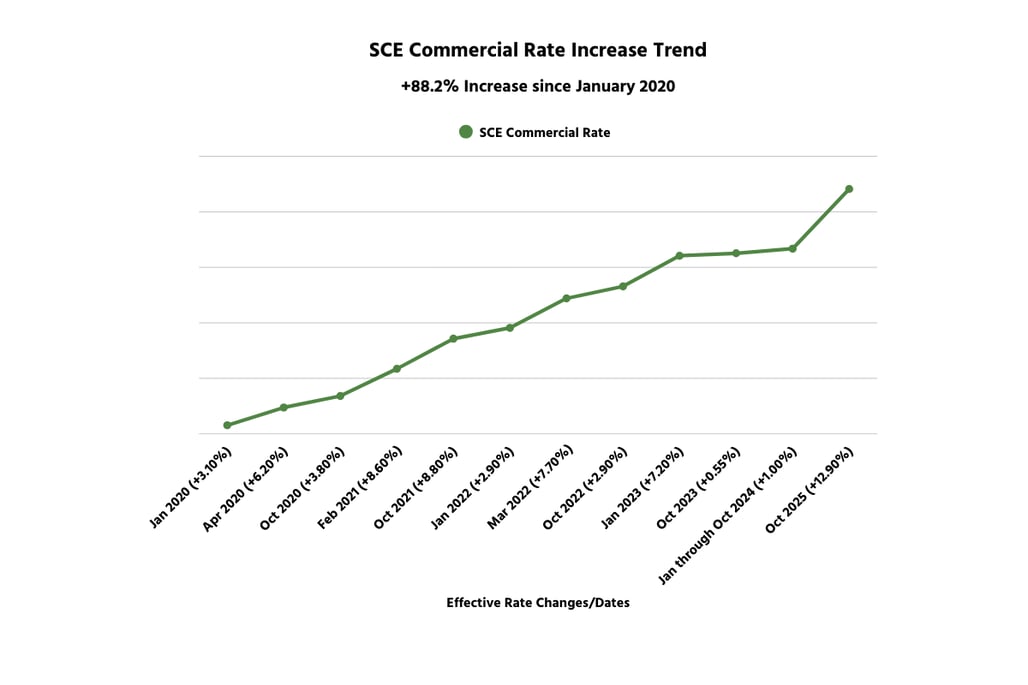
Over the past decade, Southern California Edison’s commercial electricity rates [have climbed by more than 80%.](https://www.ocpower.org/newsroom/sce-rate-changes-explained/)And these increases haven't been gradual. April 2020 brought a 7% jump. March 2024 added another 7.2%. [October 2025 pushed rates up roughly 10%.](https://www.sce.com/regulatory/tariff-books/rate-change)
## Demand Charges and Time-of-Use Complexity
Demand and peak pricing create a real financial threat for businesses. A brief period of high usage can affect costs for the entire billing cycle, even when overall consumption remains steady. And now Facilities-Related Demand charges stack on top of time-variant energy charges. For businesses that can't shift operations outside peak windows (retail, restaurants, medical facilities, etc.), these costs are unavoidable.
## What's Behind the Increases
Most of the cost comes from wildfire mitigation. SCE is upgrading[over 1,000 miles of overhead power lines and burying 212 miles of infrastructure](https://download.newsroom.edison.com/create_memory_file/?f_id=68279ba73d63328626179ab2) in high fire-risk areas through 2028. In January 2025, the CPUC also approved SCE's request [to recover close to $2 billion in costs](https://www.sce.com/save-money/rates-financing/sce-rate-advisory/20251001) related to the 2017-2018 Thomas Fire and the mudslides that followed.
Grid modernization accounts for the rest. The September 2025 regulatory decision set SCE's base revenue requirement at [$9.76 billion for 2025](https://www.cpuc.ca.gov/-/media/cpuc-website/divisions/energy-division/documents/general-rate-cases/sce/fact-sheet-sce-grc-091825.pdf), with approved increases continuing through 2028. For commercial customers, that translates to rate adjustments that show up every year, not just during major rate case cycles.
## Pacific Gas & Electric Rates
## The Decade in Numbers
PG&E’s electricity rates today look nothing like they did ten years ago. Residential rates have more than doubled since the mid-2010s, and commercial customers have been on the same upward track. In fact, residential rates increased [104% between January 2015 and April 2025](https://www.publicadvocates.cpuc.ca.gov/-/media/cal-advocates-website/files/press-room/reports-and-analyses/250827-public-advocates-office-q2-2025-rates-report.pdf).
Since 2022, higher revenue goals and additional costs have driven a series of rate adjustments [by roughly 40%](https://www.cpuc.ca.gov/industries-and-topics/electrical-energy/electric-rates). Rather than a single step change, customers have experienced successive increases that have compounded over a relatively short period of time, making electricity costs harder to project.
## Regional and Sector Impacts
PG&E serves a geographically diverse area, which means commercial rates and their impacts vary by region and industry. Agricultural customers in the Central Valley face different rate structures than office buildings in San Francisco or industrial facilities in the East Bay. Time-of-use schedules also don't align across sectors. A food processing operation running 24-hour shifts will have different cost exposure than a retail location with predictable daytime hours.
Wildfires add another layer. The cost recovery proceedings don't wait for general rate cases to conclude. When PG&E needs to recover expenses tied to specific events or infrastructure programs, those requests move through separate regulatory channels and show up on bills when approved.
## What's Behind the Increases
Wildfire mitigation dominates PG&E's cost picture. The utility plans to invest $7.4 billion to reduce wildfire risk on its electric distribution system between 2023 and 2026. [That includes more than 1,600 miles of underground electric line](https://www.linkedin.com/posts/power-delivery-intelligence-initiative_pge-achieves-milestone-with-1000-miles-activity-7382394666593325056-_b0e?utm_source=share&utm_medium=member_desktop&rcm=ACoAAB3-OiwBuBRSM7sqBb6SAlVMf8XJZV3smg8), plus [over a billion in vegetation management](https://energysafety.ca.gov/news/2023/12/29/energy-safety-approves-pges-2023-2025-wildfire-mitigation-plan/).
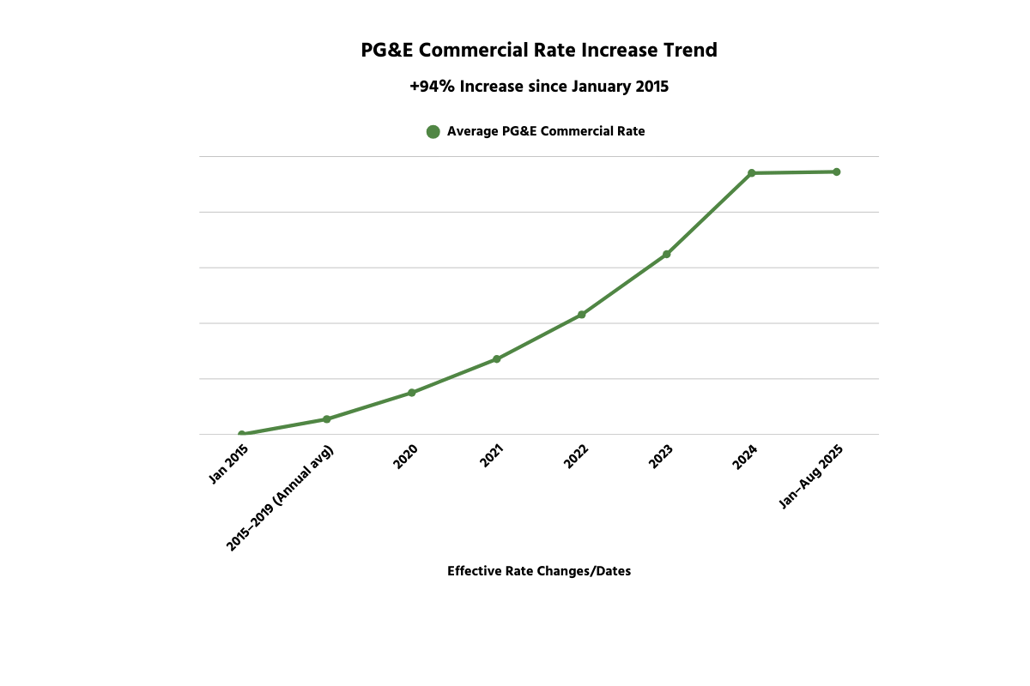
Distribution costs have grown faster than any other component of PG&E's revenue requirement. Transmission and distribution expenses more than doubled between 2016 and 2025. Those costs fund grid modernization, accommodate load growth from electrification, and address decades of deferred maintenance.
In late 2024, [PG&E requested an additional $3.1 billion for grid connection work](https://www.publicadvocates.cpuc.ca.gov/press-room/commentary/250423-pge-seeks-another-multi-billion-dollar-rate-increase) in 2025 and 2026, on top of $3.2 billion already authorized. The utility cited increased project complexity and higher costs for contract labor. For commercial customers, these escalating infrastructure investments translate directly into higher per-kilowatt-hour charges and demand fees that compound annually.
## Why Upcoming Increases Matter
Rate increases have always been painful, but they used to be easier to absorb. Many businesses treated them as sunk costs and then adjusted budgets. What’s different now is that new increases are landing on rates that are already high.
## Compounding Effects on Operating Margins
When electricity prices rise from a higher starting point, each additional increase carries more weight. A 6% or 8% adjustment today doesn’t land the way it did ten years ago, especially for facilities with large loads, tight margins, or fixed tenant agreements.
A business that absorbed a 10% electricity increase in 2023 and another 7% in 2024 isn’t dealing with a simple 17% change. Those increases build on each other, raising costs on a base that keeps moving upward. For businesses with thin margins, such as grocery stores, restaurants, convenience stores, and small manufacturers, a few percentage points can be the difference between profit and loss.
Electricity costs also show up everywhere else. HVAC, refrigeration, lighting, and equipment all tie back to the same utility bill. When rates climb sharply over a short period of time, everyday operational decisions become more expensive to carry out.
## Long-Term Energy Exposure
Most commercial real estate decisions are made on 10 to 25-year timelines. Property acquisitions, capital improvements, and refinancing all depend on assumptions about future operating costs. Electricity used to be one of the easier variables to model. That’s no longer the case.
A property purchased in 2020 with an electricity budget based on that year’s rates may now be carrying costs 40% to 100% higher, depending on the utility. Refinancing in 2026 means underwriting against today’s rates, which can reduce loan proceeds or require additional equity. Development projects that were penciled in cleanly a few years ago are now being re-evaluated because energy assumptions no longer hold.
For businesses planning expansions, new locations, or major equipment upgrades, uncertainty around electricity pricing has become part of the decision-making process in a way it wasn’t before.
## Leases and Landlords
Commercial property owners face a particularly difficult challenge. Many lease agreements were negotiated when electricity costs were lower and more stable, and recovering rising utility expenses depends heavily on lease language.
Triple-net leases typically pass utility costs through to tenants, but disputes can arise when increases feel unexpected or weren’t clearly anticipated. Gross leases leave landlords covering electricity expenses that now exceed original budgets. Modified gross structures often sit in between, creating gray areas around who absorbs sudden spikes.
As new leases are negotiated in 2026, both sides are adjusting. Tenants want predictability. Landlords need protection from open-ended escalation. Finding workable terms has become harder than it was just a few years ago.
## The Commercial Solar Tax Credit and Why Timing Matters in 2026
The federal commercial solar tax credit is still available, but to maximize savings, projects need to begin now because the window is narrowing. [Business owners need to understand how the credit works](https://blog.citadelrs.com/the-big-beautiful-bill-and-commercial-and-multifamily-solar-2025-impact-and-deadlines)and what qualifications look like in 2026 matters if they want to use solar to stabilize their electricity costs.
## Commercial Qualifications
[Section 48E provides a tax credit equal to 30% of qualified solar system costs](https://www.irs.gov/credits-deductions/clean-electricity-investment-credit), including equipment, installation, and related expenses. The credit applies to systems owned directly, but it also supports third-party ownership structures such as power purchase agreements. In those arrangements, the system owner claims the credit and reflects its value through lower contracted electricity rates.
Tax-exempt entities and companies without sufficient taxable income often rely on this structure. An investor monetizes the credit and incorporates it into project pricing, allowing the benefit to flow through without requiring direct ownership.
## Timing and Eligibility
[To qualify for the full credit](https://www.irs.gov/pub/irs-drop/n-25-42.pdf), projects must either begin construction by July 4, 2026, or be placed into service by December 31, 2027. What sounds like a reasonable window can compress rapidly once site assessments, utility interconnection processes, permitting, equipment procurement, and installation schedules are factored in.
Projects that begin construction before the July 2026 deadline will be eligible, but completion still needs to occur within four years. Projects that start later have less wiggle room.
## What’s New
Eligibility standards around “beginning construction” have become more specific for larger systems. [Projects over 1.5 megawatts](https://www.irs.gov/pub/irs-drop/n-25-42.pdf) must meet physical work requirements, such as starting on-site work or manufacturing equipment under binding contracts. Placing orders or making deposits alone is no longer sufficient.
[Foreign Entity of Concern restrictions add another constraint](https://www.irs.gov/pub/irs-drop/n-25-42.pdf) beginning in 2026. Equipment sourcing now affects eligibility, narrowing supplier options and, in some cases, increasing costs or extending lead times.
At this stage, the credit itself is rarely the uncertainty. The risk lies in whether project timing, documentation, and sourcing still align by the time construction actually begins.
## Safe Harbor Deadlines
Building a commercial solar project can take months, but tax policy doesn’t wait for your project timelines. In the context of commercial solar, “safe harbor” refers to the point at which one can lock in eligibility under current tax rules before a project is fully built. A project establishes “safe harbor” by showing the IRS that construction has begun. Systems under 1.5 megawatts fall under the [“5% safe harbor,”](https://www.irs.gov/pub/irs-drop/n-25-42.pdf) under which the project owner incurs at least 5% of total system costs in qualifying expenses. Alternatively, projects under 1.5 megawatts can establish safe harbor by meeting the physical work test, requiring meaningful work to begin, such as breaking ground or starting equipment manufacturing under binding contracts. For larger systems, the physical work test is the only available option.
Once “safe harbor” is established, the project preserves its eligibility for the tax credit as long as it reaches completion within four years. This allows businesses to secure incentive eligibility now while managing installation timing around operational needs, budget cycles, or facility schedules.
The July 4, 2026, deadline to begin construction means projects need to move through planning, permitting, and initial procurement steps faster than they might have in prior years. Safe harbor doesn't extend the deadline; it simply allows completion to happen later once eligibility is locked in. Foreign Entity of Concern restrictions complicate this further. Equipment sourcing decisions made in 2026 affect whether a project qualifies at all, which means procurement timelines now include additional vetting and compliance verification steps that didn't exist before.
Construction delays themselves are nothing new. What's different is that delays can now affect whether a project still fits within the rules it was designed around. Safe harbor provides a way to account for that risk at the outset, rather than adjust after schedules have slipped. These slowdowns often happen before construction even starts and are largely outside a project team's control.
Projects that might have been scheduled for 2027 or 2028 now face a decision point. Establishing “safe harbor” in early 2026 preserves the tax credit, but it requires committing resources, finalizing designs, and securing equipment or beginning physical work before mid-year. Waiting means moving forward without federal incentives and relying entirely on utility savings to justify the investment.
## How Things are Changing Commercial Solar in 2026
Rising utility rates, tightening tax credit deadlines, and stricter eligibility requirements are coming together in ways that reshape how businesses look at solar. Projects that might have been deferred are getting reviewed sooner because waiting costs more than it used to. Utility rates are climbing faster than they have in decades, tax incentives won't be available forever, and locking in predictable electricity costs is looking less like an efficiency project and more like a fundamental operating expense decision.
## Rising Rates and ROI
Five years ago, commercial property owners could predict their utility expenses with reasonable confidence. Rate increases were part of the plan and easily built into lease agreements. That baseline is gone. Businesses that budgeted for 3% to 5% annual rate growth are seeing 10% to 15% increases instead, sometimes more. Wildfire mitigation costs alone have added billions to utility revenue requirements, and those costs aren't slowing down.
Businesses are running the numbers again on solar projects they passed on two or three years ago. A system that would have taken 12 years to pay back at 2020 rates might hit breakeven in seven or eight years at current rates. If rates continue on their recent trajectory, the math gets even better.
## Tax Credit Urgency
The 30% federal tax credit has been available for years, but the July 2026 construction deadline changes the decision. Projects that aren’t planning to begin construction by July 2026 or be placed in service by December 2027 need to either move up their timelines or accept that federal incentives won't be part of the equation. Depending on tax liability or access to third-party financing, that difference can represent 20% to 30% of total project costs.
The timelines are tight. Businesses that want the credit need to start moving through those phases now, not in six months. Projects that begin in early 2026 have margin to manage setbacks. Afterward, projects have much less room for error.
## Supply Chain Friction
Foreign Entity of Concern restrictions mean equipment sourcing just got more complicated. Vendors that were standard options in 2024 may no longer qualify in 2026, which narrows the supplier pool and can extend timelines, but there are still viable options.
The key is planning procurement earlier and working with experienced installers who have already vetted compliant suppliers and can navigate these requirements efficiently. These extended timelines just mean that businesses that want to establish “safe harbor” before the July deadline need to get moving earlier than they might have in previous years.
## The Solar Calculation Has Changed
Solar decisions used to come down to payback period and whether a business had the capital. Now there are more variables: regulatory deadlines, equipment compliance rules, utility rates that keep climbing in ways that are harder to forecast. Tax credit windows, safe harbor requirements, supplier constraints, and the pace of utility rate increases all factor into the decision now. Three years ago, most of those weren't on the spreadsheet.
The fundamentals haven't changed. Solar still works by offsetting the electricity costs you're already paying. What's changed is how much those costs have risen and how long federal incentives will remain available. Businesses evaluating solar in 2026 are looking at better economics than they were two years ago, but with less time to capture the full benefit.
## Citadel Bring Clarity to the Chaos
Commercial solar projects have more variables now than they did even two years ago. Tax credit windows, equipment compliance, extended timelines, safe harbor provisions. Most businesses don't have time to become experts in IRS documentation or track which equipment suppliers meet Foreign Entity of Concern restrictions. That's our lane.
Our team stays on top of what's changing so we can help you navigate it. We explain how tax credit eligibility works, what “safe harbor” requirements mean for your timeline, and how different financing structures affect your project economics. We can walk you through your options, whether you're evaluating direct ownership, third-party financing, or prepaid power purchase agreements.
Most projects get bogged down in the same places. Interconnection, permitting, and equipment sourcing. We help teams plan around those bottlenecks.
### Not Sure Where to Start?
Most people aren't. There are a lot of moving pieces, and the regulatory landscape keeps shifting. Our job is to make sure you understand what applies to your business and what doesn't, so you can make a decision that protects your margins and stabilizes your operating expenses.
[](https://hubspot-cta-redirect-na2-prod.s3.amazonaws.com/cta/redirect/5109481/76dd8e8f-453e-4090-a2e4-98066d78dca1)
Topics: [Electricity Bill Increases](https://blog.citadelrs.com/tag/electricity-bill-increases), [Commercial Solar](https://blog.citadelrs.com/tag/commercial-solar), [California Solar 2026](https://blog.citadelrs.com/tag/california-solar-2026), [PG&E and SCE Rate Changes For Businesses](https://blog.citadelrs.com/tag/pge-and-sce-rate-changes-for-businesses)
### [PG&E and SCE Electricity Rate Changes for California Homeowners (2026 Update)](https://blog.citadelrs.com/pge-and-sce-electricity-rate-changes-for-california-homeowners-2026-update)
[Read More](https://blog.citadelrs.com/pge-and-sce-electricity-rate-changes-for-california-homeowners-2026-update)
### [6 Simple Ways to Lower Your Energy Bill in 2025](https://blog.citadelrs.com/6-simple-ways-to-lower-your-energy-bill-in-2025)
[Read More](https://blog.citadelrs.com/6-simple-ways-to-lower-your-energy-bill-in-2025)
## Solar myths
- **Solar is expensive.**
False. Going solar actually saves you money, both initially and long-term.
### [LEARN](https://www.citadelrs.com/learn/)
- [Solar](https://www.citadelrs.com/learn/solar)
- [Energy Storage](https://www.citadelrs.com/learn/solar-battery-energy-storage/)
- [Roofing](https://www.citadelrs.com/learn/roofing/)
- [Financing](https://www.citadelrs.com/learn/financing/)
### [HOMEOWNERS](https://www.citadelrs.com/residential/)
- [Solar](https://www.citadelrs.com/residential/solar/)
- [Solar Maintenance](https://www.citadelrs.com/residential/solar-maintenance/)
- [Energy Storage](https://www.citadelrs.com/residential/solar-battery-energy-storage/)
- [Roofing](https://www.citadelrs.com/residential/roofing/)
- [Smart Panels](https://www.citadelrs.com/residential/residential-smart-panels/)
- [Customer Stories](https://www.citadelrs.com/residential/customer-stories/)
- [FAQs](https://www.citadelrs.com/residential/faqs/)
### [BUSINESSES](https://www.citadelrs.com/commercial/)
- [Solar](https://www.citadelrs.com/commercial/solar/)
- [Solar Maintenance](https://www.citadelrs.com/commercial/solar-maintenance/)
- [Energy Storage](https://www.citadelrs.com/commercial/solar-battery-energy-storage/)
- [Roofing](https://www.citadelrs.com/commercial/roofing/)
- [Portfolio](https://www.citadelrs.com/commercial/portfolio/)
- [FAQs](https://www.citadelrs.com/commercial/faqs/)
### [homebuilders](https://www.citadelrs.com/homebuilders/)
### [Service Areas](https://www.citadelrs.com/about-us/service-areas/)
[**Northern California**](https://citadelrs.com/about-us/service-areas/northern-california/)
[Vacaville](https://citadelrs.com/about-us/service-areas/vacaville/)
761 Eubanks Dr.
Vacaville, CA 95688
[(707) 925-3949](https://www.google.com/search?q=google+vacaville+citadel+roofing&sca_esv=1ff17551be336d16&rlz=1C1GCEA_enUS1209US1209&sxsrf=ANbL-n4adqZbbaVLAt2VszX_HRryHl_zmA%3A1778696582932&ei=hsEEasXKOIONm9cPhdPMiQY&biw=1536&bih=791&ved=0ahUKEwjFpfSP8baUAxWDxuYEHYUpM2EQ4dUDCBI&uact=5&oq=google+vacaville+citadel+roofing&gs_lp=Egxnd3Mtd2l6LXNlcnAiIGdvb2dsZSB2YWNhdmlsbGUgY2l0YWRlbCByb29maW5nMgUQIRigATIFECEYoAEyBRAhGKABMgUQIRigATIFECEYoAEyBRAhGJ8FMgUQIRifBUixIFC8B1jcHnABeAGQAQCYAXegAf0LqgEDOS43uAEDyAEA-AEBmAIRoALkDMICChAAGEcY1gQYsAPCAgYQABgWGB7CAgsQABiABBiKBRiGA8ICBRAAGO8FwgIIEAAYCBgeGA3CAgUQIRirApgDAIgGAZAGApIHAzguOaAH1lSyBwM3Ljm4B94MwgcFMC44LjnIBzmACAE&sclient=gws-wiz-serp#)
[Sacramento](https://citadelrs.com/about-us/service-areas/sacramento/)
1014 N Market Blvd., Suite 30
Sacramento, CA 95834
(916) 313-4720
[Santa Rosa](https://www.citadelrs.com/about-us/service-areas/santa-rosa/)
4165 Santa Rosa Ave
Santa Rosa, CA 95407
(707) 610-0650
[Fresno](https://www.citadelrs.com/about-us/service-areas/fresno/)
744 P Street, Suite 304
Fresno, CA 93721
(559) 234-3097
### [Service Areas](https://www.citadelrs.com/about-us/service-areas/)
[**Southern California**](https://citadelrs.com/about-us/service-areas/southern-california/)
[Santa Clarita](https://citadelrs.com/about-us/service-areas/santa-clarita/)
21616 Golden Triangle Road
Santa Clarita, CA 91350
(661) 295-6848
[Corona](https://citadelrs.com/about-us/service-areas/santa-clarita/)
### [Service Areas](https://blog.citadelrs.com/www.citadelrs.com/about-us/service-areas/)
[**Southern California**](https://staging-new.citadelrs.com/about-us/service-areas/southern-california/)
[Fresno](https://staging-new.citadelrs.com/about-us/service-areas/fresno/)
744 P Street, Suite 304
Fresno, CA 93721
(559) 234-3097
[Valencia](https://staging-new.citadelrs.com/about-us/service-areas/valencia/)
28920 Avenue Penn
Valencia, CA 91355
(661) 295-6848
### [about us](https://www.citadelrs.com/about-us/)
- [The Citadel Way](https://www.citadelrs.com/about-us/why-citadel/)
- [Service Areas](https://www.citadelrs.com/about-us/service-areas/)
- [Our Team](https://www.citadelrs.com/about-us/our-team/)
- [Testimonials & Reviews](https://www.citadelrs.com/about-us/reviews-testimonials/)
- [Referral Program](https://www.citadelrs.com/about-us/referral-program/)
- [Community Involvement](https://www.citadelrs.com/about-us/community-involvement/)
- [Careers](https://www.citadelrs.com/careers/)
### [News](https://blog.citadelrs.com/news)
- [In the News](https://blog.citadelrs.com/news)
- [Blog](https://blog.citadelrs.com/)
### [Contact](https://www.citadelrs.com/contact-us/)
- [Contact Us](https://www.citadelrs.com/contact-us/)
- [Request a Quote](https://info.citadelrs.com/get-a-quote)
- [Privacy Policy](https://www.citadelrs.com/privacy-policy/)
[](https://www.citadelrs.com/)
-
-
-
-
-
2026 CITADEL ROOFING AND SOLAR - CSLB License 647149
```json
{
"@context" : "https://schema.org",
"@type" : "BlogPosting",
"author" : {
"@type" : "Person",
"name" : "Citadel Roofing & Solar",
"url" : "https://blog.citadelrs.com/author/citadel-roofing-solar"
},
"dateModified" : "2026-03-17T20:20:42.146Z",
"datePublished" : "2026-03-09T22:18:09.000Z",
"headline" : "PG&E and SCE Historic and Upcoming Rate Changes For Businesses: How Utility Costs Are Shaping Solar Choices for Commercial in 2026",
"image" : [ "https://blog.citadelrs.com/hubfs/Solar_Energy_2.jpg" ],
"mainEntityOfPage" : {
"@id" : "https://blog.citadelrs.com/pge-and-sce-historic-and-upcoming-rate-changes-for-businesses-how-utility-costs-are-shaping-solar-choices-for-commercial-in-2026",
"@type" : "WebPage"
},
"publisher" : {
"@type" : "Organization",
"logo" : {
"@type" : "ImageObject",
"url" : "https://blog.citadelrs.com/hubfs/logo.png"
},
"name" : "Citadel Roofing and Solar"
}
}
```