


Storage Is Now Standard
Battery storage is becoming a standard component of modern commercial solar systems. These storage systems are commonly deployed at warehouses, manufacturing facilities, office buildings, and schools. This rise in popularity coincides with improved reliability, monitoring, and operational efficiency due to improvements in battery software and system controls. (Accure, 2025)
Modern storage systems now integrate with solar arrays and building energy management software to help businesses better control energy usage. Some systems can also participate in utility programs that reward facilities for reducing electricity consumption during periods of high grid demand. Utilities are also relying more on battery storage systems to support grid reliability and renewable energy integration. (GPC, 2024)
Batteries Are Booming
For decades, energy costs in California have been some of the highest in the U.S. The high costs and market volatility began with deregulation in 1996 (Assembly Bill 1890) (SPUR, 2003) and continue due to grid upgrades, wildfire mitigation costs, and time-of-use (TOU) pricing structures. (NRDC, 2026) This is a two-edged sword for California businesses, who not only have to deal with energy costs that are higher than their out-of-state competitors, but also find budgeting difficult without knowing what electricity costs will be next year, next month, or even next week. These businesses are under growing pressure to control long-term energy costs and reduce exposure to utility rate volatility.
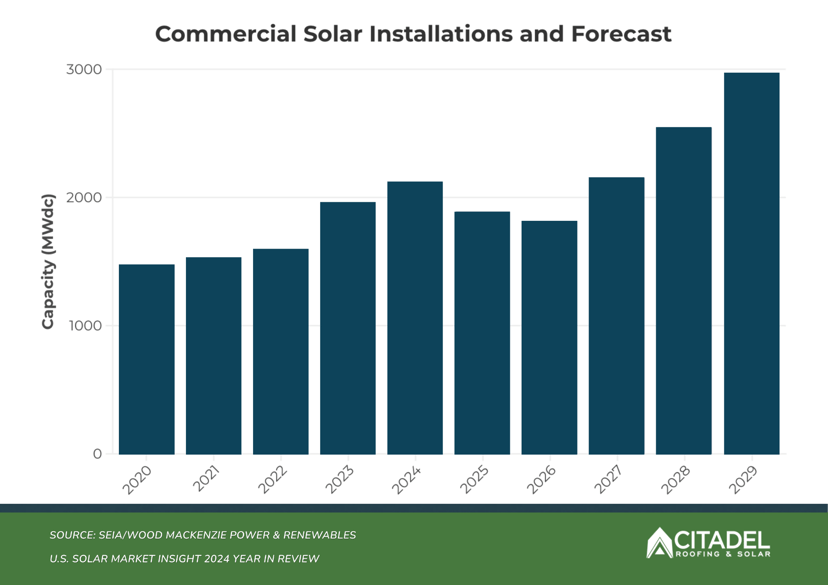
Fortunately, U.S. battery manufacturers have heard the call and are rapidly expanding their manufacturing capacity, with projected production now exceeding current installation demand in some forecasts. (ESC, 2026) Thanks to the Inflation Reduction Act, federal incentives have accelerated domestic battery production and clean energy manufacturing investment. With the easing of battery manufacturing constraints and supply chain pressure, commercial solar projects have become easier to plan and deploy. (RHG, 2025)
What Changed
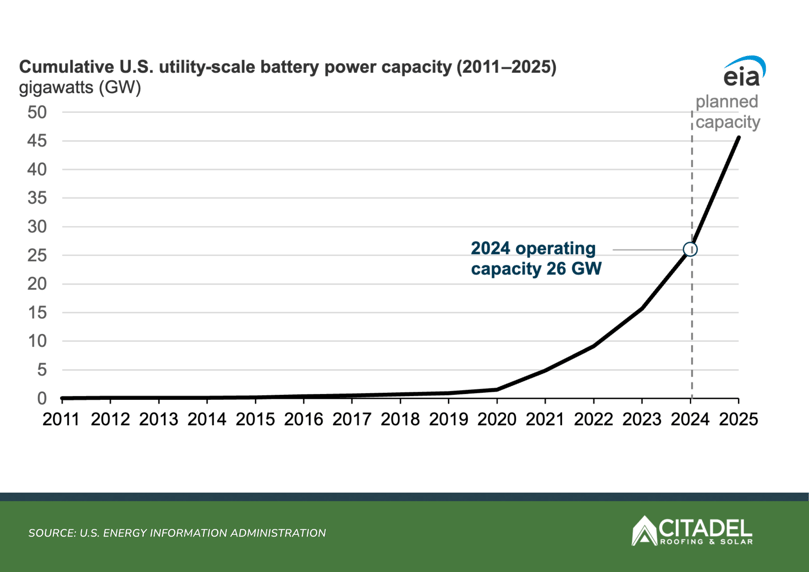
U.S. battery production capacity has expanded significantly in the past few years. In fact, battery capacity jumped by 66% in 2024 alone. (EIA, 2025) This leap has been a result of manufacturers responding to the growing demand for electric vehicles, utility-scale storage, and commercial solar battery storage systems. (Canary, 2026) Domestic factories are reducing dependence on overseas suppliers and long international shipping timelines. Efforts to reshore battery manufacturing and improve reliability were further accelerated by the supply chain disruptions during the COVID pandemic. (CSIS, 2026)
This is all good news. As supply constraints ease, increased manufacturing competition will improve equipment availability and reduce or even eliminate procurement delays for commercial projects.
Why It Matters for Projects
There are several reasons that an increase in U.S. battery production is an important benefit for new solar projects:
- Better availability may soon reduce the delays that have slowed commercial solar installation and storage deployments in the past few years
- The increase in domestic manufacturing reduces exposure to shipping bottlenecks, tariffs, and global trade disruptions (SEIA, 2025)
- Increased stability in supply chains will improve access to replacement parts and warranty coordination
- As commercial battery storage is increasingly viewed as established infrastructure rather than emerging technology, this improved market maturity increases lenders’ and investors' confidence in financing commercial solar energy projects (ENEL, 2023)
Impact on Economics
Battery prices have been dropping dramatically for years. A report from the Harvard Business School notes that prices dropped nearly 90% between 2010 and 2020. (HBS, 2026) While these prices may still fluctuate due to lithium and other raw material markets, greater manufacturing scale should help stabilize prices over time. (BNEF, 2025) For most California businesses, project economics are driven primarily by four things: utility electricity rates, demand charges, time-of-use pricing, and facility energy usage patterns. (Revel, 2022)
Battery storage creates value by reducing peak-period energy usage and improving energy management flexibility. Businesses can improve long-term cost predictability and reduce their exposure to unstable utility rates by pairing commercial solar panels with battery storage. (ACP) Interestingly, utility rate pressure remains the biggest driver behind storage adoption, not battery pricing.
What This Means for California Businesses
California businesses continue to deal with some of the highest electricity costs in the nation. Time-of-use pricing further increases those costs at times when many businesses are still using significant amounts of energy. Wildfire outages and grid reliability are also greater concerns in California than in most of the U.S. (NFIB, 2026)
A solar power system with battery storage alleviates many of these problems. Improving battery supply conditions remove a major barrier that previously complicated project planning.
As solar with battery storage becomes a long-term cost management strategy, the greater risk for businesses may now be delaying having a system installed while utility costs continue to rise.
How to Approach Solar + Storage
- Evaluate your energy needs
- Review your facility’s usage and peak demand periods and how they align with utility billing structures
- Analyze your bills for demand charge exposure, peak usage timing, and seasonal energy trends
- Evaluate solar and battery storage together to determine how they would improve your overall system economics
- Before making any investment decisions, compare solar-only, storage-only, and combined system scenarios (Anern, 2025)
- When calculating the cost of your solar and battery storage system, consider how the system will affect long-term expenses and budgeting predictability
- Be sure to include any federal, state, or utility incentives when evaluating project economics (DOE)
Let’s Put Increased Production to Work for You
The U.S. commercial energy market is currently going through a bit of a shake-up. This is partially driven by the sudden growth in domestic battery manufacturing. Domestic battery supply is becoming both more stable and more accessible for commercial projects. California businesses continue to face high energy costs and market instability, and commercial battery storage is becoming standard in commercial energy planning to lower costs and increase budget predictability.
A solar array with battery storage may be the solution to your business’ energy cost issues. Speak to a Citadel Roofing & Solar installation expert today about solar system and battery storage options.

FAQs
Why does U.S. battery manufacturing matter for commercial solar projects in California?
Domestic manufacturing improves battery availability, reduces supply chain disruptions, eliminates tariff uncertainty, and alleviates order delays for commercial solar battery projects. (SEIA, 2026)
How does domestic battery production impact commercial solar installation timelines?
Greater equipment availability reduces project delays caused by battery shortages or overseas supply chain disruptions. Increased stability makes it easier for contractors to schedule installations accurately. (R&M, 2026)
What are the benefits of pairing battery storage with commercial solar in California?
There are several benefits. A combined system reduces peak demand charges, makes energy costs more predictable, and provides backup power in the event of a grid failure. A battery makes it possible to use solar-generated electricity during expensive utility rate periods. (DOE, 2021)
How do U.S.-made batteries help businesses qualify for clean energy tax incentives?
Some federal clean energy incentives include domestic content considerations tied to U.S.-manufactured equipment. Eligibility requirements vary based on project structure and incentive program rules. (IRS, 2026)
Will increased U.S. battery manufacturing lower commercial solar storage costs over time?
Increased production and competition tend to stabilize pricing over time. However, your project savings will be most affected by utility rates and demand charges. (DOE)
How long do commercial battery storage systems last?
Most commercial battery storage systems last between 10 and 20 years, depending on the battery chemistry, usage patterns, and maintenance practices. Many systems also include performance warranties that guarantee a certain storage capacity over time. (NREL, 2025)
Can battery storage help California businesses during power outages?
Yes. Battery storage systems can provide backup power during outages. This can help businesses maintain critical operations, stay open, and protect sensitive equipment during grid disruptions. (CPUC)
Why are demand charges important for commercial solar and storage projects?
Battery storage can help reduce these peak demand spikes by supplying stored energy during high-usage periods, which may lower monthly utility costs. (NREL, 2022)
Are commercial battery storage systems only beneficial for large businesses?
No. While large facilities often see significant savings, smaller commercial properties can also benefit from improved energy cost predictability, backup power capabilities, and reduced exposure to peak electricity pricing. (EcoFlow, 2022)
Why is California a major market for commercial battery storage?
California’s high electricity costs, time-of-use pricing structures, renewable energy goals, and grid reliability concerns have made battery storage increasingly valuable for businesses across the state. (CPUC)